Longtermism Is Counting Wrong
If future lives count, then the future lives created by saving people today have to count too.

Longtermism begins from a good impulse.
Human beings already have an unusual ability to care about distant consequences. We plant trees whose shade we may never sit under. We build institutions that outlive us. We educate children for worlds we will not see. We pass down knowledge, tools, laws, stories, and warnings.
Longtermism tries to extend that horizon even further. At its best, it asks a serious question: how can we use reason, evidence, and scale to make choices today that preserve more value tomorrow?
That is a worthy project. But I think there is a mistake hidden in the way some longtermist arguments count. They sometimes speak as if future people are already waiting somewhere, morally equivalent to people alive today, just located later in time.
But future people do not exist yet. What exists now is the structure that may produce them: living people, knowledge, institutions, technology, health, coordination, trust, and culture.
So if we are going to reason about the future clearly, we should not compare “present people” against “future people” as if they were two separate populations standing in different rooms.
We should compare the full future consequences of each choice.
And so, a problem appears. If future lives count, then the future lives made possible by saving people today have to count too.
Okay. Let’s strip the problem down to its cleanest form.
No quality-of-life differences. No intelligence differences. No contribution differences. Just headcount. Apples to Apples.
One person equals one person.
Now imagine a simple choice. You can either save 100 people today, or 100 people in the future.
In its simplest, most naive form of the calculation, if the future intervention can save more than 100 people, it looks better.
But this quietly makes a huge mistake.
It treats the 100 people saved today as if their causal effect ends the moment they are saved. As if they remain frozen in the accounting. As if they do not continue living, acting, relating, reproducing, and shaping the future.
But they do. So let’s look at this example.
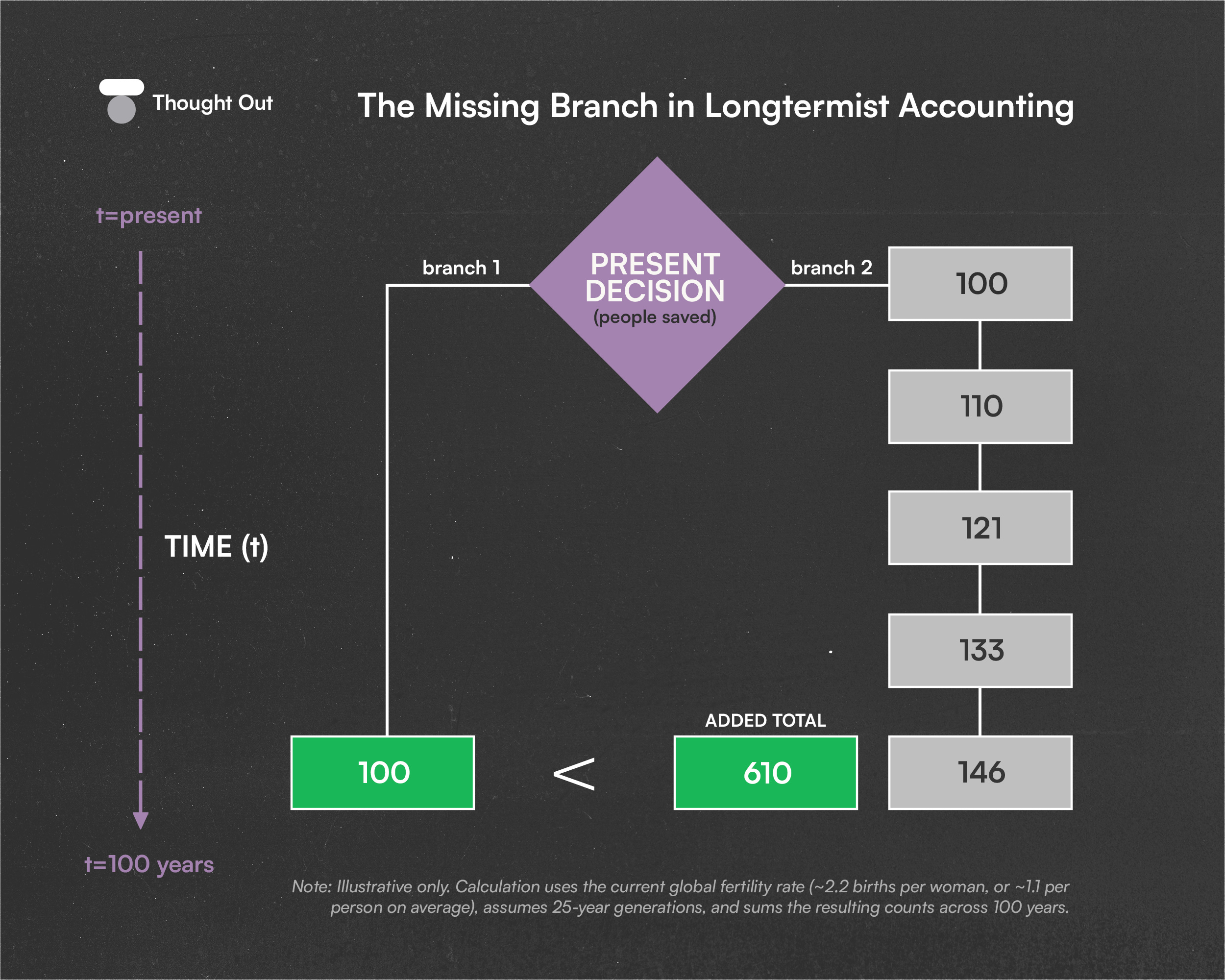
Using the current global pattern, fertility is roughly 2.2 children per woman, or about 1.1 children per human when averaged across men and women.
So if you save 100 young people today, and we use 1.1 people per person per generation as a simple estimate, the outcome looks like this:
Today: 100 people
After 25 years: 110 people
After 50 years: 121 people
After 75 years: 133 people
After 100 years: 146 people
Across the 100-year window:
100 + 110 + 121 + 133 + 146 = 610
So in this 1simplified headcount model, saving 100 young people today does not preserve only 100 people.
It preserves a future with 610 extra people in it (counted across the 100-year window).
That means the future intervention does not merely need to beat 100. It needs to beat 610.
It needs to show that saving people 100 years from now produces more value than the 100-year branch preserved by saving people today.
And this is still the weakest version of the argument.
Headcount’s not enough. Besides reproducing humans also contribute. They teach, build, repair, coordinate, discover, transmit knowledge, etc. So the reproductive branch is only the simplest visible layer.
But before adding any of that, there’s a basic accounting mistake already visible. You can’t count the future on one side and pretend the people saved today have no future of their own.
The Hidden Vantage-Point Mistake
There is a real difference between saving a person from death and creating the conditions for a person to exist. But that difference only has its obvious force in the present.
If a living person is standing in front of us, and another person is merely possible, the difference is real. One exists. The other does not. That is what creates the moral asymmetry.
But when we talk about saving people 100 years from now, something strange happens in the mind. We quietly move our imagination into the future. We picture that future person as already alive. Already real. Already standing there, in danger.
From inside that imagined future-present, the comparison feels obvious:
This person exists. The other person is merely hypothetical.
But that is not where the actual decision is being made. The actual decision is being made now. And from now, both people are not-yet-born.
The person who will be saved from death 100 years from now does not exist yet.
The person who will exist because someone was saved today also does not exist yet. Both are possible future people.
So the future-focused argument cannot borrow the moral force of a present living person and apply it to its own imagined future person. That is the mistake.
It steps into one possible future, treats the people there as already real, then steps back into the present and dismisses the people in the other possible future as merely hypothetical.
But from the real present, both futures are hypothetical. In one future, a person is born and later saved from death. In another future, a person is born because earlier lives were preserved.
Those stories are different. But the difference does not automatically give priority to one side. It has to be argued. It cannot simply be smuggled in by imagining one future as if it has already happened.
So the clean rule is this. If your not-yet-born future people count, then my not-yet-born future people count too. And the fair comparison is not: present people versus future people. It is: one possible future versus another possible future. Branch versus branch.
There is another way to see the asymmetry. Imagine the person making the intervention today could travel into both possible futures.
In one future, they meet someone who was saved from death because of their actions. They can say:
“If I had not acted, you would have died here. Because I acted, you got the rest of your life.”
That is a real contribution. But in the other future, they meet someone who exists because of their actions. To that person, they can say:
“If I had not acted, the conditions that made your life possible would not have existed. Because I acted, you got your entire life.”
That is also a real contribution. One intervention preserves the remaining part of a life. The other makes an entire life possible.
Headcount Is Only the First Layer
So far, we have kept the calculation deliberately simple. We counted people as people. Nothing else. No contribution. No knowledge. No care. No institutions. No culture. No technology. No capacity.
But even in that stripped-down version, the mistake is already visible: saving people today does not only affect the present. It changes the future that grows out of the present.
And once we add back the real complexity of human life, the argument becomes stronger. The contribution side of the story matters a lot.
Descendants are only the most obvious output. They are the biological continuation. But there is also a functional continuation.
A person alive today is part of the machinery that produces the future: future people, yes, but also future knowledge, future tools, future institutions, future culture, future coordination, and future problem-solving capacity.
So the deeper point is this: present capacity is upstream of future capacity. Or in other words, future capacity depends on present capacity.
The future does not appear from nowhere. It is produced by the structures alive now. And those structures are made of people.
This is easier to see with computers. Modern computer chips are not designed by hand. They are designed using existing computers. Present compute helps create future compute.
So if you destroy computation today, you are not merely losing today’s computation. You are damaging the system that would have helped create the next generation of computation.
The same structure applies to humans. Present human capacity helps create future human capacity.
Present scientists help create future science.
Present teachers help create future minds.
Present parents help create future people.
Present institutions help create future stability.
Present artists help create future culture.
Present engineers help create future tools.
Present communities help create future trust.
So when we talk about sacrificing present people for future people, we have to be careful. Present people are the producers of the future. They are the living system through which the future becomes possible.
The mistake, then, is not only that longtermism sometimes undercounts descendants. The deeper mistake is that it can undercount present capacity itself. Because a saved life is not just a life preserved. It is a source of future capacity kept online.
And so the burden of proof changes.
You can still argue for a future-focused intervention. But you cannot simply say: “This saves more future people than saving people today.”
You have to show that it still wins after counting what was lost by not saving people today: their lives, their descendants, their relationships, their knowledge, their work, their care, their influence, and all the future capacity that would have flowed through them.
That is the bigger picture. The future is not separate from the present. The future is computed by the present.
Longtermism is right to ask us to think beyond the present. But if we are going to count the future, we have to count it consistently.
We cannot count future people in one scenario while treating people saved today as if their influence ends at the moment of rescue. People alive today are not just present-tense beneficiaries. They are part of the machinery that creates the future.
This does not mean present lives always outweigh future lives. It means the comparison has to be honest.
If a future-focused intervention wants priority, it has to beat the whole branch preserved by saving people today: their lives, their descendants, their relationships, their knowledge, their work, their care, their influence, and the future capacity that would have flowed through them.
A saved life is not a point. It is a branch. And the future is not separate from the present.
The future is computed by the present.
This is not meant as a precise demographic forecast. Real population dynamics are more complicated: generations overlap, fertility changes, some descendants may replace people who would otherwise have existed, and the relevant moral unit may be person-years, welfare, or capacity rather than simple headcount. The point of the example is only illustrative. It shows that saving people today does not merely preserve a fixed number of present lives. It preserves a causal branch that can extend into the future.